
By Carla G. Hart
There’s been a lot of talk about illegal immigration over the last five years. Pew Research reported that 14 million unauthorized immigrants were living in the U.S. in 2023, an all-time high. The U.S. Citizenship and Immigration Services reports an 89% approval rate for citizenship applications.
Legal immigration, the naturalization ceremony, and stories of people who go through the process to become naturalized citizens are mostly left untold.
Forty-Eight People Became Citizens on February 20, 2026, in North Carolina’s Middle District
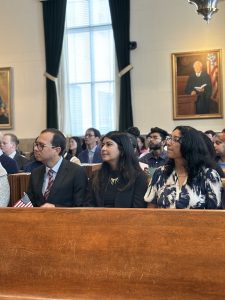
Lindsey A. Freeman, United States District Judge, presided over a moving naturalization ceremony for 48 people who applied and passed the test and other requirements for naturalization at the U.S. District Court in Greensboro, North Carolina.
“You studied and dreamed, took a chance, put in the hard work and dedication needed to become an American citizen. Today you will take the Oath of Citizenship, and we will welcome you as fellow Americans,” Judge Freeman told the men and women sitting before her in the majestic, 100-year-old courtroom.
The Judge encouraged each new citizen to embrace their citizenship by voting, serving on a jury when called, and getting involved in local governance.
Judge Freeman administered the Oath of Allegiance for Citizenship, followed by all in the courtroom standing to recite the Pledge of Allegiance to the Flag.
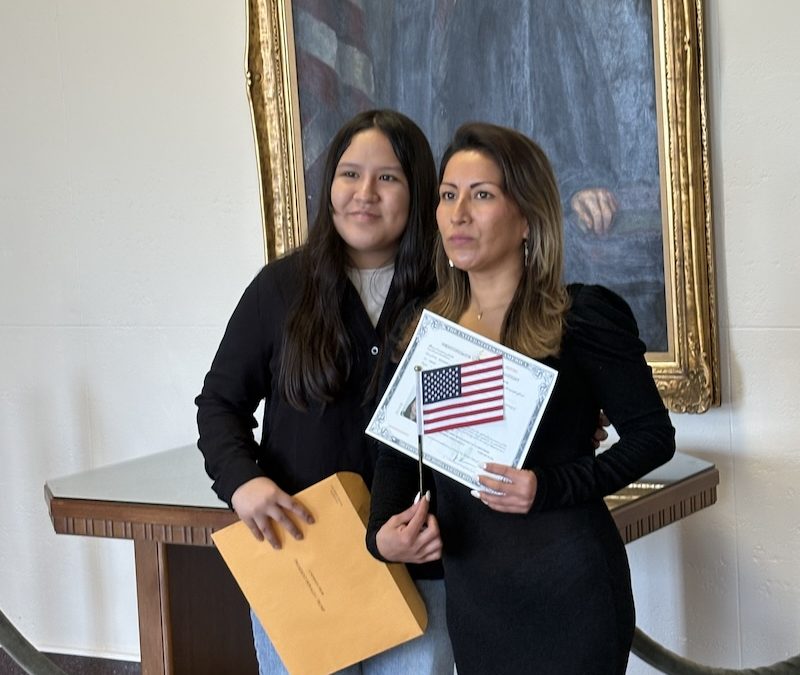
Each new citizen came forward to receive their Certificate of Naturalization and to share their name, country of origin, and any comments. Most of them made humble statements of appreciation; some spoke of the long journey to citizenship and of their love for America.
Exiting the podium, they were each greeted by members of the Colonel Arthur Forbis Daughters of the American Revolution (DAR) Chapter.
June Curlott, Regent of the Colonel Arthur Forbis DAR, was all smiles, saying, “It’s a lot of fun to be here, serve refreshments, and welcome our new citizens with an American flag and pocket copy of the U.S. Constitution.”
A Trio sang America the Beautiful by Katherine Lee Bates and This Land is Your Land by Woody Guthrie.
Outside the courtroom, the DAR ladies poured punch and served cookies and other snacks, where new citizens and their families gathered to celebrate.
At the Reception, New Citizens Spoke About What Being an American Means to Them
Amom from Vietnam said, “I’m so happy. Took me four years to get here.”
Maggie from Mexico said, “My son helped me; encouraged me. I love the history of America.”
Launysoza from Brazil noted, “I’ve been here for 27 years working. I’m very happy to finally become a citizen. I loved my country, but it is not the same; it has many troubles. America is my home now.”
Mason from Vietnam smiled and simply said, “I love American philosophy. I’m proud of the USA.”
Viktoria from Poland came to America with her family at age seven. They returned, but at thirteen, she chose to return. “I chose to come back and finally become a citizen. I am proud of American history.”
Perla from Chile said, with tears in her eyes, “So beautiful and moving to be part of this ceremony. Finally! I have waited a long time.”
Priyamvada from India, tearfully said, “I’m so happy and thankful. My son is here, and he helped me come and go through the process to become an American.”
François from the Congo laughed out loud – “I am very happy today!”
Shesttpal and his wife from Pakistan said, “We are physicians. It is a blessing to become citizens. We love the culture and America.”
The Oath of Allegiance is a Codified Embodiment of Key American Principles
The Oath contains key principles codified in Section 337(a) in the Immigration and Nationality Act (INA). The underpinning of the oath is support for the U.S. Constitution.
Oath Of Allegiance
“I hereby declare, on oath, that I absolutely and entirely renounce and abjure all allegiance and fidelity to any foreign prince, potentate, state, or sovereignty, of whom or which I have heretofore been a subject or citizen; that I will support and defend the Constitution and laws of the United States of America against all enemies, foreign and domestic; that I will bear true faith and allegiance to the same; that I will bear arms on behalf of the United States when required by the law; that I will perform noncombatant service in the Armed Forces of the United States when required by the law; that I will perform work of national importance under civilian direction when required by the law; and that I take this obligation freely, without any mental reservation or purpose of evasion; so help me God.”
Most Applications for Citizenship are Approved
According to the U.S. Citizenship and Immigration Services (USCIS), 2.6 million people became U.S. citizens between 2022 and 2024. The application approval rate is 89 percent.
In 2024, 818,500 people were approved for naturalization.
Mexico (13.1%) and India (6.1%) represent the largest numbers of naturalized immigrants, followed by the Philippines (5.0%), Dominican Republic (4.9%), and Vietnam (4.1%).
The majority of new citizens live in California, Florida, New York, Texas, and New Jersey.
Eligibility for U.S. Citizenship is Easy to Achieve
- Must be at least 18 years of age
- A lawfully admitted permanent resident
- Continuously lived in the U.S. for at least five years after having been lawfully admitted for permanent residence
- Physically present in the United States for at least 30 months of the five years preceding the date of the application
- Lived at least 3 months in the state or service district where the application was made
- Lived continuously within the U.S. from the date of application for naturalization up to the time of admission to citizenship
- Proven to be a person of good moral character, attached to the principles of the Constitution of the U.S., and favorably disposed toward the good order and happiness of the United States (Criminal background check and FBI clearance)
- Is not a deserter of the U.S. Armed Forces or those persons who departed from the U.S. to evade military service in the U.S. Armed Forces
Applicants are privately interviewed at this point to review their N-400 application, tested in English and U.S. civics, and questioned under oath or affirmation by an examining officer to verify background, travel history, and moral character.
The U.S. Civics Test Might Challenge Natural Born Citizens
The civics test assesses knowledge of U.S. history and government. As of 2025, applicants are randomly tested from a list of 128 questions. They must answer 12 out of 20 questions correctly.
Check out the test here: https://www.uscis.gov/sites/default/files/document/questions-and-answers/100q.pdf